Probably the best book I’ve ever read on what the scientific method really is, how scientists build models, how they deal with randomness, uncertainty and the pitfalls of induction.
— Brian Clegg, Popular Science
What does it actually mean to say something is “likely” in science?
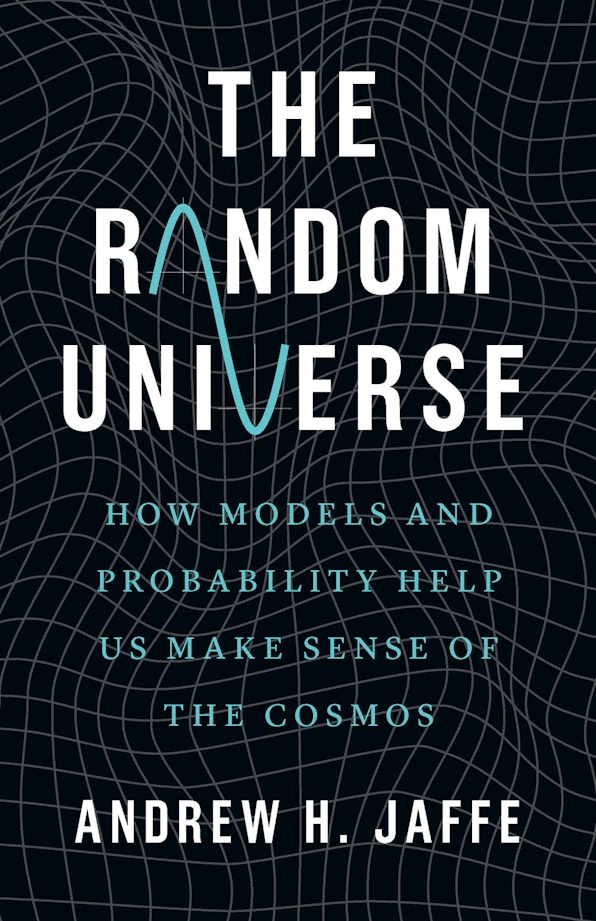
The Random Universe explores how scientists use probability to draw conclusions about the universe from limited, uncertain data — and what we really mean when we call a theory “likely.”
It tells the story of how scientists use data to interpret and model the universe, combining philosophy and the history of science — from David Hume’s question of whether we can know anything more than what we experience, to the work of Thomas Bayes and modern cosmology. With examples such as Eddington’s 1919 eclipse expedition confirming Einstein’s theory of gravity, it shows how models and probability are used to predict and explain — and why scientific conclusions are always, in some sense, uncertain.
ISBN 978-0-300-25050-3 · 288 pages · Hardcover, ebook · Addenda & errata
Prefer a quick introduction? Watch a short talk about the book here, or find recent and upcoming appearances.
Praise
We don’t live in a clockwork universe; the real world is messy and imperfectly predictable. Andrew Jaffe’s delightful book shows us that randomness can be just as beautiful as rigidity.
— Sean Carroll, author of The Biggest Ideas in the Universe
Andrew Jaffe demystifies the role of probability and uncertainty in the scientific process, guiding readers through the logic that underpins inference and discovery. An essential read.
— Priyamvada Natarajan, Yale University
Astrophysicist Andrew Jaffe has written a fascinating book about how we know what we know, and how we express our current knowledge of the world.
— Andrew Gelman, Columbia University
Shockingly, he shows how uncertainty is at the root of every physical law.
— Sir Brian May, musician & astrophysicist
Reviews
Physics World book review (Chrysi Malouchou Kanellopoulou) · 12 August 2026
A masterful and refreshing take… uncertainty is not a hindrance to knowledge, but an opportunity to learn (and learn more) about the world.
Popular Science five-star book review (Brian Clegg) · 17 June 2026
This is an absolutely fascinating book for anyone interested in the way that science really works, bearing in mind the difficulties of having to base our models and theories on induction.
Nature Astronomy book review · 14 May 2026
The book works. It takes you from the reliability of London buses to the Big Bang in a circuitous but continuous path, leaving you with an accomplished feeling of having slotted parts of the Universe and parts of our understanding into their logical places. … While not a casual read, it is an accomplished one.
Nature, Modelling the cosmos and imagining a future without meat: Books in brief · 6 March 2026
“The sun and the stars and the edge of the Universe are inaccessible, but no more so than the interior lives of other people,” writes astrophysicist Andrew Jaffe in his intriguing book about epistemology, probability and cosmology.
Enjoyed the book? A short review on Goodreads or Amazon really helps others find it.