16 years after publication, I (along with, I hope, my co-authors and co-editors) am about to receive my first (meagre) royalty check for our book, Bayesian Methods in Cosmology. We argued, more controversially than it might now seem, that this is the best way to think about cosmological data.
Month: October 2026
Should remember not to wear dark trousers on days when I’m teaching at the blackboard.
In Paris for a typically French PhD viva: universities shut due to student protests — but they are letting thesis examinations go on.
In Paris for about 10 hours. (First and last Eurostar.)
Speaking about The Random Universe this Thursday, October 15, at the Hampstead Scientific Society — come and learn how we know what we know, and how we might be wrong, about the Big Bang and, perhaps, everything else.
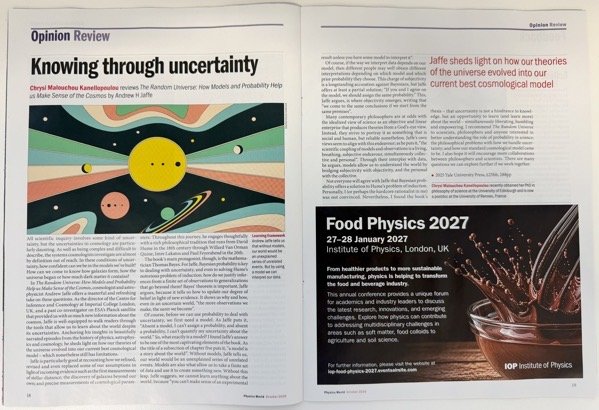
This appeared online over the summer, but hardcopy is cooler.
First tutorials of the year (3 hours today, 3 more hours tomorrow): second-year quantum mechanics. “Light as a wave” and/or/vs “Light as a particle”…
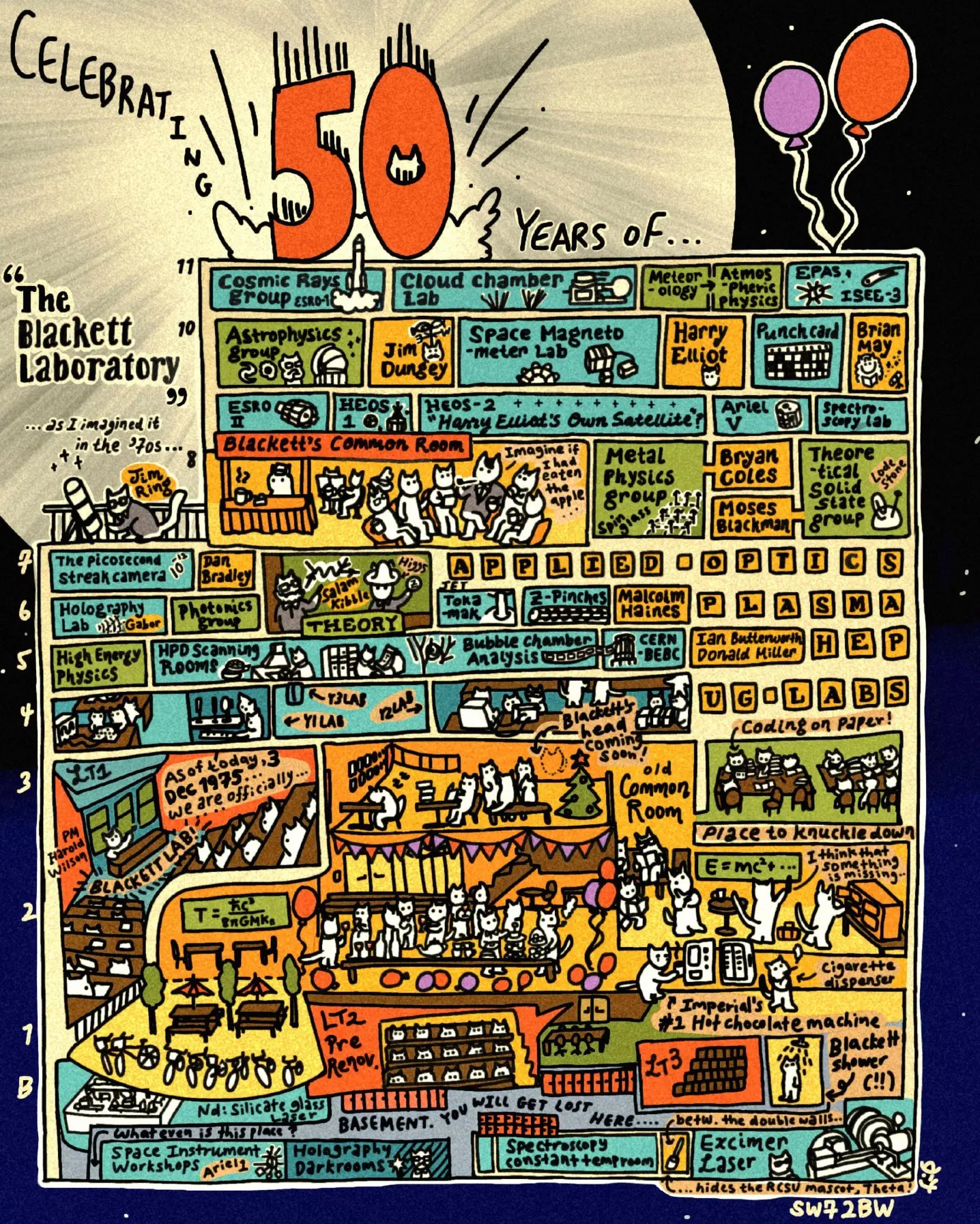
Celebrated 50 years of The Blackett Laboratory, home of Imperial College Physics. The building is about 65 years old but was named after Blackett in the 70s, part of 150 years of physics teaching and research in this part of London.
Radchenko & Wheeler’s new LLM-assisted proof settles the real quadratic case of Hilbert’s 12th problem. Corollary (Appleby, Flammia & Kopp): SIC-POVMs exist in every dimension, so any quantum state can be written as a constrained probability distribution — good news for QBists, if it holds up.
Here’s a puzzle based on the artwork from the review of The Random Universe appearing in this month’s print edition of Physics World.
Francis Halzen wins the 2026 Physics Nobel Prize for pioneering neutrino astrophysics using detectors sunk into the antarctic ice – one of those crazy/brilliant ideas that seems inevitable and obvious in retrospect, observing the trails behind neutrinos speeding through the ultra-clear deep ice.
Off to give my first undergraduate lecture in nearly 6 months — two hours to start a half term on Information Theory — probability, communication, entropy, all emanating from a Bayesian perspective on Claude Shannon’s codification of information.