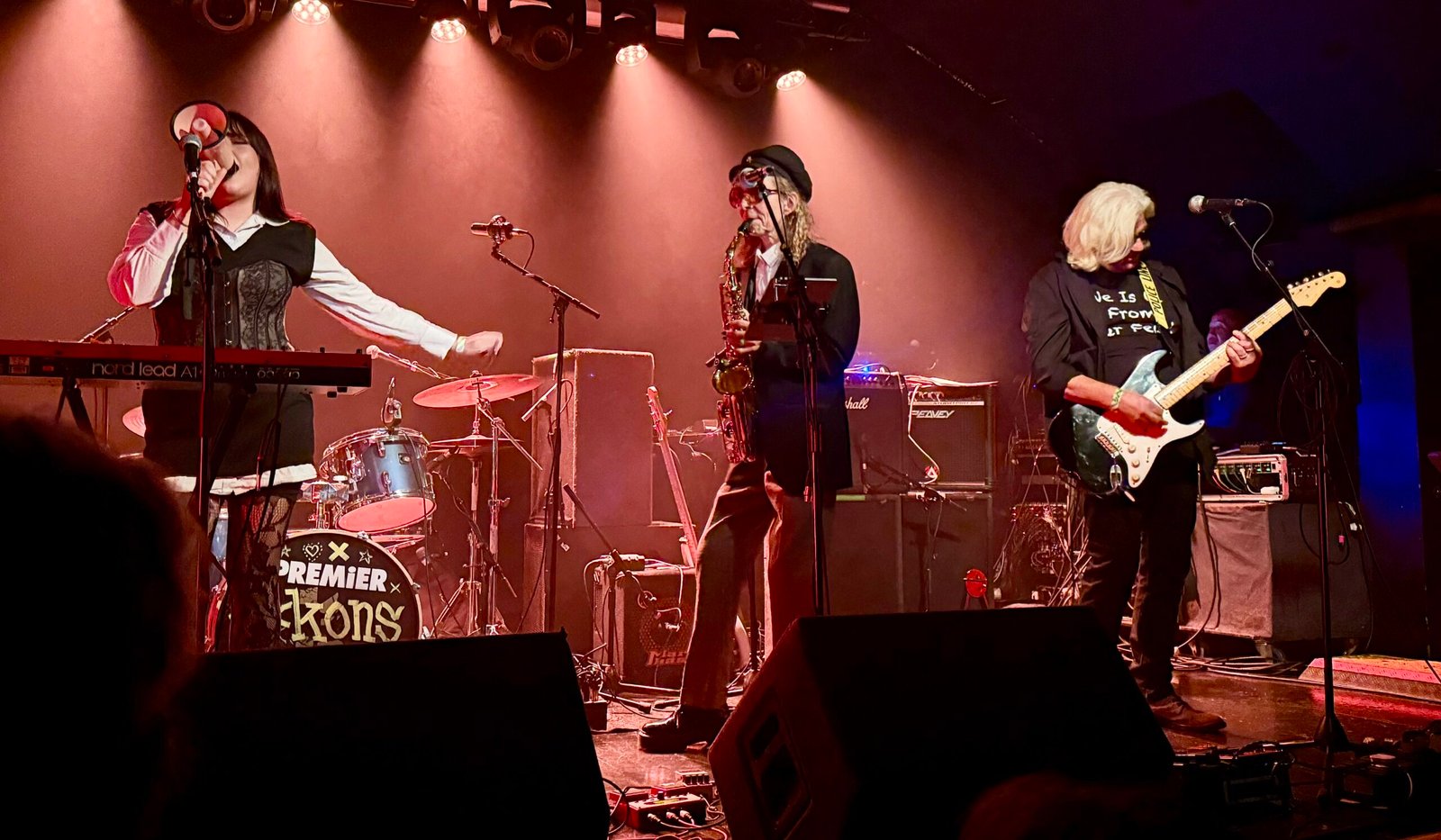
I suspect many of you will not appreciate what an honor it was to hear Lora Logic and her band Essential Logic play the X-Ray Spex classic “Oh Bondage! Up Yours!” opening for the Mekons tonight.
Short posts from Andrew Jaffe
I suspect many of you will not appreciate what an honor it was to hear Lora Logic and her band Essential Logic play the X-Ray Spex classic “Oh Bondage! Up Yours!” opening for the Mekons tonight.
The Mekons are the greatest rock’n’roll band in the world. And I suspect I’m not the only person travelling to see them tonight at the Garage in North London on a TFL 60+ Travelcard.
16 years after publication, I (along with, I hope, my co-authors and co-editors) am about to receive my first (meagre) royalty check for our book, Bayesian Methods in Cosmology. We argued, more controversially than it might now seem, that this is the best way to think about cosmological data.
Should remember not to wear dark trousers on days when I’m teaching at the blackboard.
In Paris for a typically French PhD viva: universities shut due to student protests — but they are letting thesis examinations go on.
In Paris for about 10 hours. (First and last Eurostar.)
Speaking about The Random Universe this Thursday, October 15, at the Hampstead Scientific Society — come and learn how we know what we know, and how we might be wrong, about the Big Bang and, perhaps, everything else.
This appeared online over the summer, but hardcopy is cooler.
First tutorials of the year (3 hours today, 3 more hours tomorrow): second-year quantum mechanics. “Light as a wave” and/or/vs “Light as a particle”…
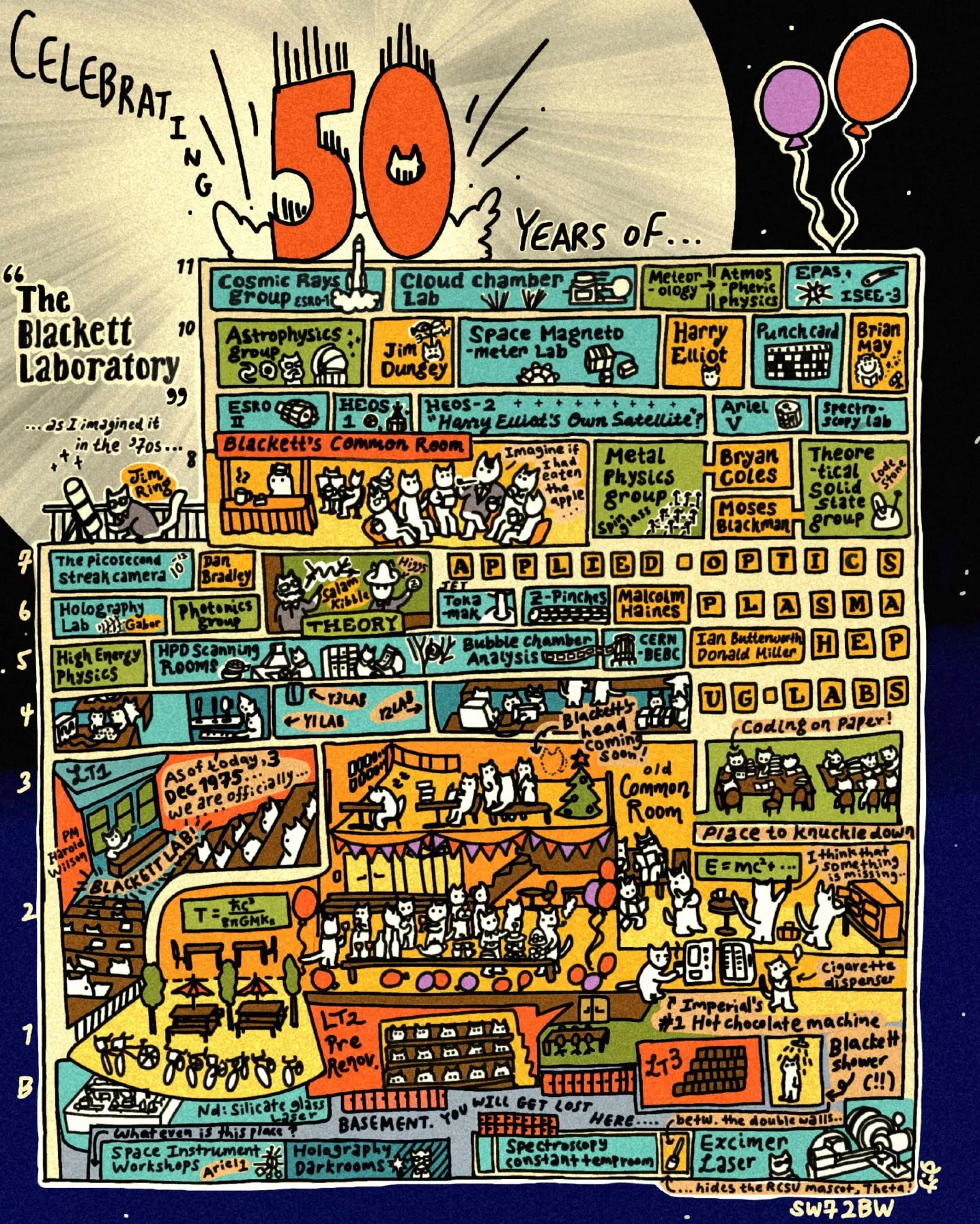
Celebrated 50 years of The Blackett Laboratory, home of Imperial College Physics. The building is about 65 years old but was named after Blackett in the 70s, part of 150 years of physics teaching and research in this part of London.
Radchenko & Wheeler’s new LLM-assisted proof settles the real quadratic case of Hilbert’s 12th problem. Corollary (Appleby, Flammia & Kopp): SIC-POVMs exist in every dimension, so any quantum state can be written as a constrained probability distribution — good news for QBists, if it holds up.
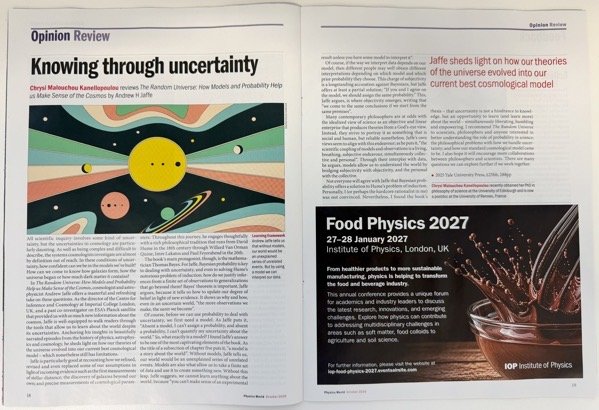
Here’s a puzzle based on the artwork from the review of The Random Universe appearing in this month’s print edition of Physics World.
Francis Halzen wins the 2026 Physics Nobel Prize for pioneering neutrino astrophysics using detectors sunk into the antarctic ice – one of those crazy/brilliant ideas that seems inevitable and obvious in retrospect, observing the trails behind neutrinos speeding through the ultra-clear deep ice.
Off to give my first undergraduate lecture in nearly 6 months — two hours to start a half term on Information Theory — probability, communication, entropy, all emanating from a Bayesian perspective on Claude Shannon’s codification of information.
Niche query (mostly US expats dealing with taxes): is Free File Fillable Forms down for everyone else?
I just received a message from a colleague that a proposal we had been working on was “tabled” at a meeting. I hope that this means it was brought up and considered, but there is a nagging worry that it could also mean set aside.
First solo trip to NYC in more than a decade, visiting the Simons Foundation Flatiron Institute for their Learning The Universe meeting.
New post: The Talk I Gave on September 12
More 25th anniversary thoughts and recollections. I was heading off to Durham, in the north of England — my first big talk now that I had started my permanent academic job. I arrived toward the end of the first day of the conference: September 11, 2001.
New post: Second test post
Here’s an excerpt!
New post: Test post
New post: 25 & 60
Twenty-five years ago, I moved from San Francisco to the UK, from a fellowship at Berkeley to a permanent job at Imperial College, London. A lot has changed since then. I was 35; now I am 60. It was two weeks before 9/11; the world hasn’t seemed as open and free since.
As of last week I’ve been living in the UK for 25 years.
Due to a booking mishap (mine) we are beset by the horror of an extra night in Southwest France.
I’ll be in New York 14–19 September. If anyone knows of a seminar slot, a podcast, a bookshop, or a living room that might want a cosmologist talking about probability, epistemology, and The Random Universe — I’d love to hear from you. Very short notice, entirely shameless.
NASA’s Roman Telescope Leaves Earth to Chart the Stars
The latest great space telescope, targeting the history and evolution of the Universe and planets around other stars, launched by NASA in collaboration with astronomers around the world.
“From the Mixed-Up Files of Mrs. Basil E. Frankweiler” — a childhood favorite I’ve just finished reading with my kids, a bit younger than Claudia & Jamie in the book — was as wonderful as I remembered. Whenever we go to a museum they’ll be scouting out places to sleep, and secrets…
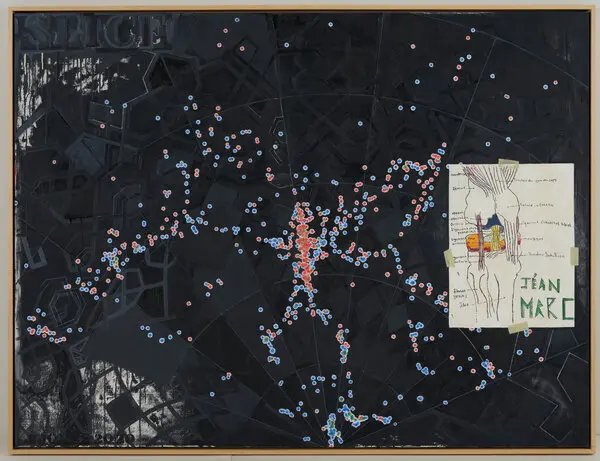
Jasper Johns’ “Slice”, a mashup of the CfA galaxy redshift survey, spied on a visit to the Guggenheim Bilbao. I recognised the pattern of dots — famous among cosmologists — from across the room, surprised to see it amongst Johns’ usual flags, targets, crosshatches, and numbers.
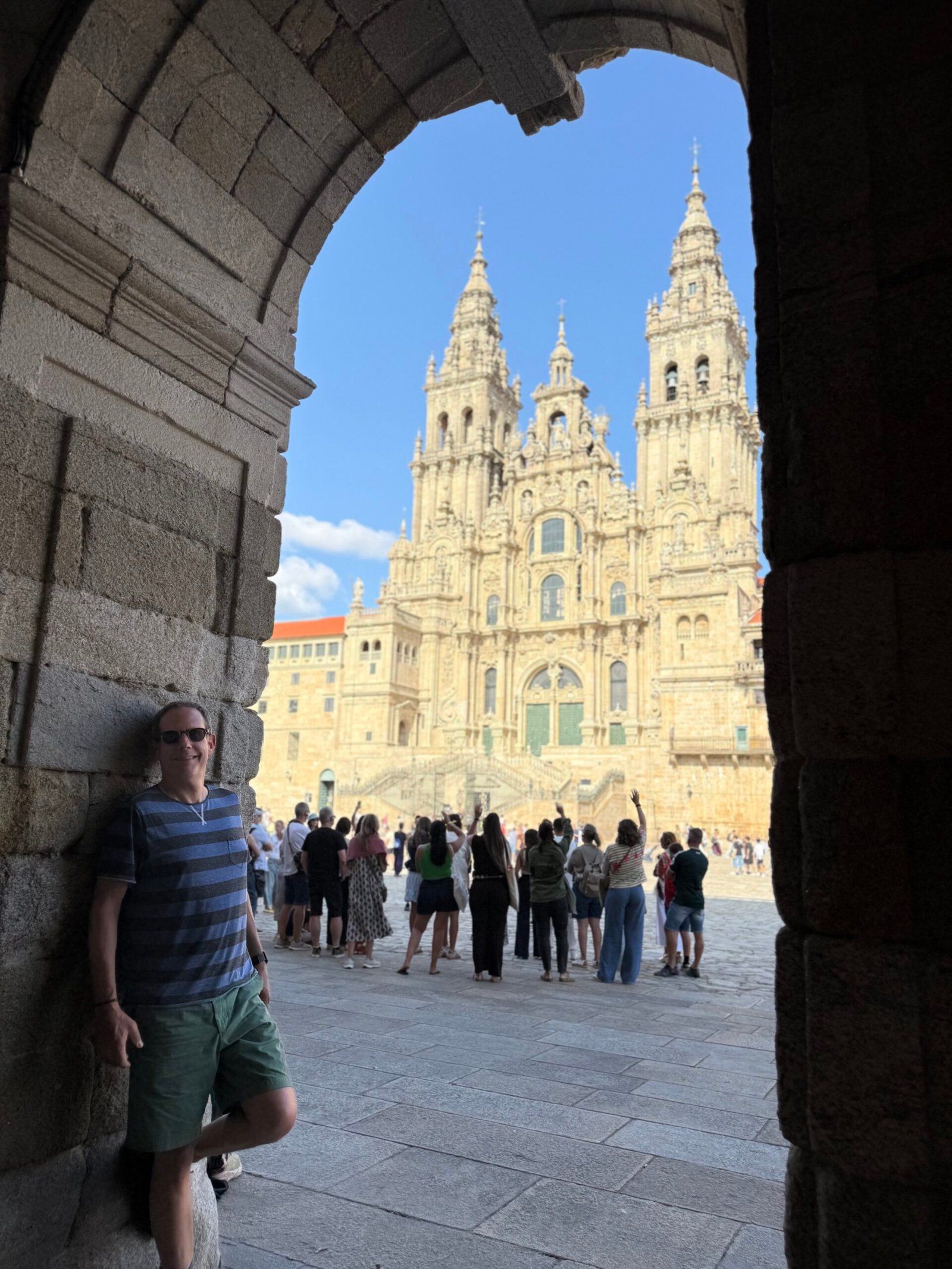
Being an atheist and born Jewish, and only having walked the last 20km of the Camino de Santiago, I was surprised to feel so moved by our arrival at the Cathedral.
Casualty, lost to the rocks of the iron-age fortifications of Os Castros de Baroña, Galicia.